
THE BLOSSOMING OF BLUR, 1990

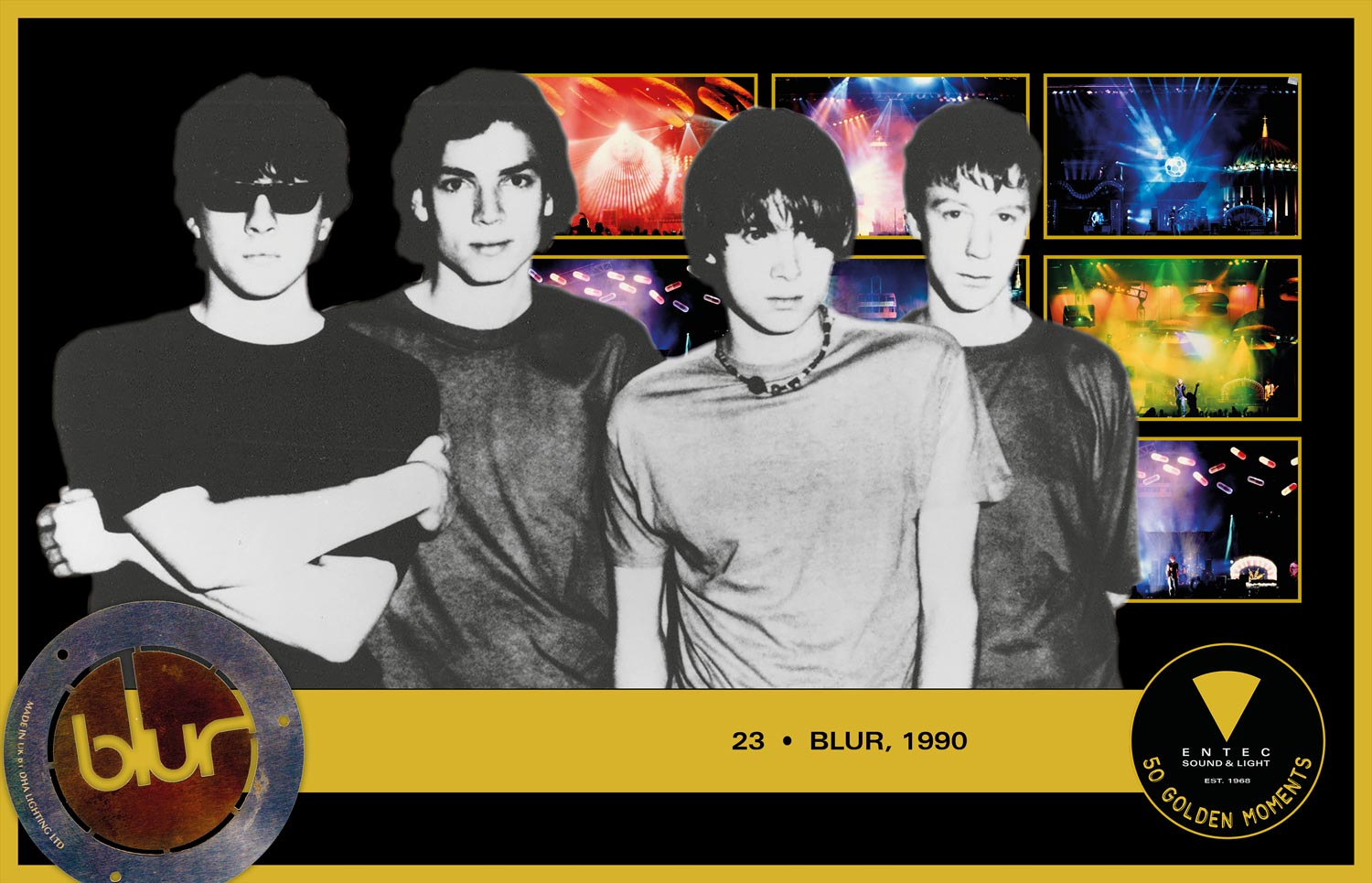
In many ways direct descendants of The Kinks and XTC, Blur and their brazen art school demeanour helped to define the new confidence of the Nineties and give birth to a genre that the media described as ‘BritPop’. As the band’s longest-serving production partner, Entec is sincerely proud to have assisted Blur’s rise from provincial clubs to some of the world’s largest arenas and festivals. Their partnership began in 1990, however, like most great stories, this one has an interesting prequel.
Founded at Goldsmiths College in London by childhood friends Damon Albarn and Graham Coxon, with Alex James and Dave Rowntree, Blur began life in the summer of ’89 as Seymour, playing a handful of pub gigs in and around the capital, where they were courted by Food Records, the indie label established by ex-Teardrop Explodes keyboard player David Balfe and Andy Ross.
At Balfe’s insistence, Seymour changed their name to Blur before signing to Food the following March. In the meantime, the stars were aligning for Dave Byars, an aspiring young Scots lighting designer who was heading down the A1 and about to be handed a golden opportunity.
Dave takes up the story: “In the spring of 1990, I was doing some roadie work in Edinburgh for my friend’s heavy metal band Trixx Federation. They had started to enjoy some success and came down to London to play support slots at the Marquee Club.
“I was also biding my time, working for other bands there, and Phil Stephens, the club’s then principal LD, kindly recommended to Entec that my work was worth checking out. Noreen and Adam came along to the club one night to see me lighting Jah Wobble & The Invaders Of The Heart and, as a result, I was offered a job as one of the Marquee’s house LDs.
“The Marquee was always a great place to meet other roadies, like Oscar Harris, the LD with Pop Will Eat Itself, and Tony Fagan, the lighting guy for Jesus Jones, the Food act that were supported by Blur at the Kilburn National. Tony very kindly put me forward to work with Blur and set up a meeting with Damon and David Balfe. We got on well and I was asked onboard as their LD that day, joining Jason Cox as the Blur crew. My first gig with them was at Junction 10 in Walsall on July 1st and the adventures started from day one!”
Blur’s first show with Entec as their lighting provider was at the Zap Club in Brighton on October 16th 1990. Dave recalls: “Dealing with Noreen and Adam, you just knew you were in the safest, most amenable hands. They supplied some extra fixtures to add to the house rig as well as power and cabling, which was roughly the pattern for the first couple of years.
“The kind of equipment we were renting from Entec included Optikinetics Solar 250 projectors, Quasar strobes and strobe flowers, which the band really loved because they could cut through smoke and make a big visual statement.
“It probably goes without saying that in those early days, I was reliant on whatever house console was available and, naturally, the results varied. We were playing the Tic-Toc in Coventry and when the Quasars were set off, they wiped the house desk’s memory so I ended up just winging it the whole night!”
Dave retains many a golden memory connected with design experiments and “Heath Robinson” attempts to contrive bespoke equipment with the aim of giving Blur a unique edge. He says: “Boff [Simon Howarth] at Entec was especially helpful. He’d build things like small controllers to change effects wheels. One of the crazier ideas was to fit Molefay blinders and scrollers into fridges, and smoke machines and strobes in cooker grills or wardrobes. Dave Gibbon and Ray Whelan made this happen time and again, without them blinking an eye.
“Noreen and the band gave us free rein to get as creative and as odd as we liked. Anything that Entec had in the warehouse was fair game – including bits of neon, fluorescent tubes, practicals, architecturals and redundant reflectors – all concepts were considered no matter how unwieldy or mad.
“Hangman were also a great help. They manufactured anything we couldn’t fashion ourselves. As well as the usual backdrops, I particularly liked the huge lamp shades on stands they made to house runs of flexi flash and strobes, as well as picture frames hiding loads of arcline.”
At this early stage, David Balfe was an essential part of the creative melting pot, not only as the director of Blur’s first two promo videos – for ‘She’s So High’ and ‘There’s No Other Way’ – but also as a frequent contributor of design brainwaves.
Dave: “That Zap Club gig was actually the first time we took out anything that you could vaguely describe as ‘production’. At David’s suggestion, we hung interchangeable transparencies over two 6’ x 6’ backlight boxes that were specially made for us. They looked great but, to be fair, these light boxes were a pain because the venues were often so small that there was very little room for our multitasking merchandiser friend Ali Payne to slip behind the drum kit and change the images song by song.
“Like a lot of ideas that maybe didn’t work the first time around, they were later reconfigured as something else. In this case they were turned into disco boxes and then reimagined as projection screens with a see-through plastic trim, producing the effect of strobed paintings. Those projected elements were very in-vogue at the time; it seemed to be part of that whole ‘baggy’, neo-psychedelic period.”
PROMINENCE
As with so many things in life, it’s the journey and its many adventures that matter most. Many of Blur’s early exploits were captured in the 1993 fly on the wall VHS documentary ‘Starshaped’, whose cover art (centre) featured drum tech Stuart Lowbridge passed out on a bed.
Dave points out that Blur’s rise to prominence could not have happened at a better time. “The gigs were so exciting and typical of what was going on at the start of the decade, but it was a slow burn for us… it was hardly an overnight success.
“Our ambitions for show design blossomed as we continued on the university and theatre circuits, and it wasn’t until 1994 that we really started to build up the production for events like the Alexandra Palace gig which was filmed for the Showtime video.”
Nineteen ninety-four was the year that saw security man Darren ‘Smoggy’ Evans and backline tech Jason Cox swell the crew’s ranks. As the Parklife album was released that spring, Entec’s role expanded when its sound department became involved and Matt Butcher was hired as FOH engineer.
“I met Dave at the Marquee during one of my many stints as a house engineer and we got on very well from the start,” recalls Matt.
“He was hanging around the monitor desk with me on a club night when he kept saying how I should come and work for this band he was lighting. Dave’s sometimes unforgiving Scots accent, combined with the loud music, made it hard to decipher who he was talking about. Oh, Blur! Of course, I knew their music and was very impressed with the Modern Life Is Rubbish album. That’s when the seeds were sown.
“After a spell of touring in Europe with New York band Madder Rose came to an end, there was a window of opportunity to meet Blur and their tour manager Ifan Thomas down at John Henry’s where they were rehearsing.
“I was over the moon when they offered me the gig. As I’d been working for Entec since the late ’80s when it was based in Shepperton, I already had a good relationship with Noreen and as soon as I teamed up with Blur, I persuaded their management to bring Entec onboard as our audio supplier.”
Mixing on a Soundcraft 800 console, Matt’s first Blur show was on April 15th 1994 in Rennes, France, on a university campus festival called Rock’n’Solex that offered a combination of live music and power cycle racing.
Matt: “Blur were hands down brilliant; they were gnashing at the bit and so tight. I learned that their previous FOH guys hadn’t really understood the band but, luckily for me, it all fell into place… unlike our splitter bus which parted company with its exhaust on the way home.
“A few weeks later, we kicked off the UK Parklife tour at Rock City in Nottingham and it was all starting to go crazy. I was on a Yamaha PM3000 for that tour and on that first date, someone hurled a pint of beer in my direction, drenching the desk and forcing me to run the show in mono from the left-hand buss whilst mopping up with my T-shirt.”
TRANSITION
On June 17th 1995, three albums into their career, Blur’s big leap forward came with their most ambitious move to date. Broadcast live on BBC Radio 1, the occasion was the band’s own headlining show at Mile End Stadium with special guests including The Boo Radleys, Sparks, Dodgy and The Cardiacs. One of the most famous gigs of the ’90s, it sold out rapidly, attracting 27,000 fans and transporting the band into pop’s premier division.
“None of us had done anything on that scale before… it was astonishing,” says Dave. “I presented some set design sketches to the band and they went with one that featured St Paul’s Cathedral, giant 4’ x 8’ fibre glass hamburgers and an amusement arcade.
“The set was covered in all sorts of practical lighting fixtures from Entec’s stock: huge curves of household bulbs, tons of architecturals arrayed in art deco fans and, of course, neon signs. Each of the burgers was populated with 12 Martin Pro 400 colour changers which blasted out from holes that were big enough for their lenses to be cut in the sides.
“Another great piece that Hangman made for us was the six foot football mirror ball that ended up in the Hacienda and, later, Peter Hook’s back garden.”
An Avolites Diamond II console ran the conventionals, practicals and effects lighting, including Solar 575s that Skippy Monk “just about” focused before doors. Andy Emmerson was also on the crew, operating the Clay Paky Golden Scans that positioned in the rig and as part of the set.
“As we were programming the gig, there was a definite sense that we were biting off more than could be chewed,” recalls Dave, “but once the show was up and running, we relaxed into it and absolutely loved it. The band playing an absolute blinder, of course.
“We – the band and immediate crew – were blazing hot then and it was Noreen and Entec that managed to facilitate the transition so brilliantly by bringing in additional crew who had the right level of experience. The rest of us were learning from these top professionals and it was so valuable.”
On the audio front, however, Mile End posed a number of technical challenges. “It was a big deal for Entec’s sound department,” claims Matt. “Dick Hayes had come onboard as the company’s new head of sound that April; he took one look at the inventory, another look at the gig and shook his head.
“When I started working for Entec, they were still using the Martin Audio split rig, around eight stacks of Court and some Martin RS1200s. Then they bought into the JBL Concert Series PA system, some of which had been assigned to the Marquee, however, it wasn’t terribly efficient in terms of sound quality for anything above club level. The rigging was also very laborious.
“Being one of Entec’s resident boffins, I redesigned the crossover cards to enable greater level at the top end and we replaced the subs with single 18” enclosures from Paul MacCallum’s company, Wembley Loudspeaker. These modifications then made the system more viable, especially in short-throw applications.
“With this show looming, we pored over everything in the warehouse and tried to work out what we could use to form the biggest possible system with five-wide frames using the JBL rig and Wembley bins as the basis of the design. I was using a 40-channel Soundcraft 8000 at FOH by then and it was a relief that the end result was actually pretty good.”
OVERDRIVE
Directly after Mile End, the nation’s youth witnessed the biggest chart battle in decades, when both Blur and Oasis released their latest singles on the same day in August.
‘Country House’, a song inspired by the then semi-retired David Balfe, was seen to be in direct competition with the Gallaghers’ ‘Roll With It’ for the coveted No.1 position, and the media went into overdrive when Blur won the so-called ‘The Battle of BritPop’.
Meanwhile, back in Northolt, forward-thinking Dick Hayes had identified a need to significantly upgrade the PA stock with a system that would cope with the increasing demands of arena touring.
With this in mind, he arranged a ‘shootout’ at HDS Studios in Southall, where Entec’s existing JBL rig was pitched against Turbosound Floodlight, EAW KF850, a prototype of Martin Audio’s Wavefront and a new system from d&b audiotechnik.
Says Matt: “Dick and I spent an afternoon playing CDs and putting our voices through these systems, EQ-ing each of them as we went along. Then we came to d&b’s C402 which sounded spectacular as soon as we turned it on and it didn’t require any EQ whatsoever. As Dick has said before, we all stepped back in amazement, totally blown away!
“This was also the first time I heard a B2 sub and that was a game-changer for me. I’d never heard anything like it. Dick and I agreed we had found the new Holy Grail, and in doing so, the company’s sound department was virtually reinvented on the spot.”
While Entec awaited delivery of its order from the German manufacturer, a demo version of the d&b system was sent out on Blur’s Seaside tour in September 1995, which included dates in such ‘sleepy’ English coastal town venues as Cleethorpes’ Pier 39, Oscars in Clacton and Brighton’s Paradox nightclub.
Matt: “We had eight stacks of C4 and two B2s per side, and that system was so powerful in those small venues that I just remember giggling at the impact it was having.
“Entec’s investment was so well timed for Blur. By the end of ’95, we were on our first headlining arena tour [The Great Escape], playing 14 sold-out shows including three at Wembley, and that became a standard for us. It really was a golden time.”
Soon to be joined by tour manager Craig Duffy and monitor engineer Dave Guerin, Blur had truly arrived. There would be many more successful tours and hit records, and a long pause followed by highly anticipated reunions with headlining shows in Hyde Park.
Entec is honoured to have shared the journey all the way through to the present with Damon Albarn’s Gorillaz, The Heavy Seas, The Good, The Bad and The Queen, and his acclaimed stage adaptation of Wu Cheng’en’s 16th century novel ‘Journey To The West’. Far from over, it remains one of the key journeys that continues to define Entec as a company.
Blur ‘Showtime’ – the Alexandra Palace concert, 1994

